fools despise wisdom and instruction.” [Chapter 1, verse 7]

Minister’s Letter (2026)
[2022 letters], [2023 letters], [2024 letters], [2025 letters]
How many people ever read the book ‘Proverbs’ in the Bible? Probably very few. But when I forgot to do something the other day, despite being reminded about it several times by various people, then early one morning the realization dawned upon me with a horrible shock, and I knew I needed to act NOW, these words popped into my mind –
“Go to the ant, you lazybones;
consider its ways and be wise.
7 Without having any chief
or officer or ruler,
8 it prepares its food in summer
and gathers its sustenance in harvest.
9 How long will you lie there, O lazybones?
When will you rise from your sleep? [from Proverbs Chapter 6]”
A memory from childhood probably, for my problem is procrastination, putting off until tomorrow what I should do today. Someone must have drawn my attention to these verses! I’m a ‘last minuter’; unlike the ant in Proverbs who gets on with things so as to be ready in time for the winter.
The sayings in Proverbs, possibly put together around 700 BC or thereabouts, make up a collection of words of insight for learning about wisdom, for gaining instruction in wise dealing, righteousness, justice, and equity. You might not agree with them but they give food for thought. There are many pithy and amusing sayings:
“Like vinegar to the teeth and smoke to the eyes,
so are the lazy to their employers.” [Chapter 10, verse 26]
“Like a gold ring in a pig’s snout
is a beautiful woman without good sense.” [Chapter 11, verse 6]
Proverbs is the sort of book you can ‘dip into’ which makes it very readable, unlike other books in the Bible which can be hard going. Despite being written so long ago the ideas it has to offer are largely as relevant today as they were thousands of years ago. Human beings don’t change much. Maybe this summer you might find time to read a few verses of Proverbs every now and then, savour them, reflect on them, and be wiser for it.
“The fear of the LORD is the beginning of knowledge;
fools despise wisdom and instruction.” [Chapter 1, verse 7]
August
IF DREAMS GET YOU INTO PRISON, THE SAME DREAMING WILL TAKE YOU OUTDear friends in Christ, God's time is the best time. The Bible says the foolishness of God is wiser than the wisdom of human beings. With God all things are possible. There are moments in life when we doubt our God-given talents or when others doubt what God gave us as individuals and even call us names, but God's time is the best time.
In Genesis 37, we hear the story of Joseph the son of Israel or Jacob. Joseph was a handsome boy and his father loved him more than others because he was given to him in old age. Joseph had many talents and the greatest of them from God was to dream and being able to interpret dreams.
It is the dreams that got him into trouble with his brothers. One day in Gen 37:5 he told his brothers a dream which pointed to him being a saviour to his brothers and the whole family. Because of this, the hatred became even deeper. It culminated in him being arrested and thrown into a pit and later getting sold.
If dreams get you into trouble, God will use the same dreams to take you out of trouble. After being sold and later coming to Egypt, Joseph was then in Egypt, in Potifer's house. He was arrested again and put into prison. This is where God comes in with his powers to make dreams and interpretation of dreams take Joseph out of prison.
Genesis 41 states that Pharaoh had a troubling dream which non of his officers would interpret or explain. Eventually Joseph had to be called from prison to explain the dreams of Pharaoh. Dreams got Joseph into trouble and God freed him through dreams again.
Dear friends, let us hold fast to our God-given faith. We were given the faith by God and that faith in him will see us through. There are many times that people have called you names or doubted that which God gave you. Do not despair; God will see you through. If God-given talents seem likely to take you into difficult times, the same God-given talents will serve us.
Be blessed, be safe,
Fr Alex Mahlava
Heavenly Father,
I thank You for the unique gifts and talents You have placed in me;
reveal them to me clearly
and help me to use them for Your glory.
Amen
July
Rocks and Living Stones
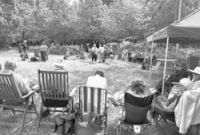 Trinity Sunday, 31st May, over thirty people gathered for an open-air service in the beautiful setting of Evenley Wood Garden. The theme, God is my Rock, was taken from Psalm 62:
‘Truly God is my rock and my salvation;
He is my fortress, I shall never be shaken.’
Although there are many references to rocks in the Bible, just three rock-related readings were chosen.
• Memorial Stones - Joshua 4.4-9
Penny explained that when the Israelites crossed the river Jordan, Joshua commanded 12 men, one from each tribe, to pick up a stone from the middle of the Jordan. These stones were set up like a cairn to remind the people how God cut off the flow of the river so they could safely cross over.
 • Ebenezer (which means ‘stone of help’) - 1 Samuel 7.7-12
Fr Alex told how stones featured in victories in Israel’s history, including David slaying Goliath with a single stone.
Samuel set up an Ebenezer stone after the Philistines were defeated and said, ‘Thus far the Lord has helped us’.
• Living Stones - 1 Peter 2.4-6. Liz talked about Jesus being the chosen and precious foundation stone of the church and how we are living stones being built up into a spiritual household. Sometimes this is an uncomfortable process as we try to fit together and as we are shaped to become more like Jesus.
Scribing Stones
 Stones were handed out and people wrote on them words which were on their hearts and minds.
Later these stones were carefully built into a cairn on the solid foundation stone, representing Jesus.
Stones were handed out and people wrote on them words which were on their hearts and minds.
Later these stones were carefully built into a cairn on the solid foundation stone, representing Jesus.
 Living Stone Plants (Lithops)
As a reminder of the occasion, each person was given a small living stone plant to take home, along with their scribed stone. Lithops comes from a Greek word meaning ‘stone face’ – the plants resemble stones so that grazing herbivores don’t eat them. If carefully nurtured, these plants should grow and eventually produce daisy-like flowers.
We pray that, with right conditions, our lives, our churches and our Benefice will grow and flourish.
 During the service three hymns, including ‘Rock of Ages’, were sung and prayers were led by Fr Alex.
The following blessing ended the worship.
May God keep you in all your days.
May Christ shield you in all your ways.
May the Spirit bring you healing and peace.
May God the Holy Trinity drive all darkness from you
and pour upon you blessing and light. Amen.
Warm fellowship and plenty of delicious food followed the service.
 Over lunch some people attempted the Trinity Triangle Challenge to link up 9 triangles into one big triangle. It doesn’t look much of a challenge in black and white, but the red, blue and green coloured dots all had to be in the correct places.
 A collection was taken for the Teachers’ Incentive Scheme at Wulu Girls Primary School, South Sudan.
Due to the congregation’s generosity this amounted to £263.33, which will be a tremendous help to the school.
A collection was taken for the Teachers’ Incentive Scheme at Wulu Girls Primary School, South Sudan.
Due to the congregation’s generosity this amounted to £263.33, which will be a tremendous help to the school.
We were blessed by the weather and by coming together as a Benefice.
Grateful thanks go to all who helped to make this a memorable occasion, and especially to Evenley Wood Garden for allowing us to use the venue.
A final rocky note: The bedrock at Evenley Wood Garden includes beds of mudstone, limestone and sandstone. The sandstone creates a band of acid soil in an otherwise predominantly alkaline area, which allows rhododendrons, camellias, and magnolias to thrive there.
May
FATHERS' DAY - 21st JUNE
‘If you want to know how well a person understands Christianity, find out how much they make of the thought of being God’s child and having God as their Father.’ (J I Packer, Knowing God)
This month we celebrate the importance of fathers on Father’s Day. Unlike Mothering Sunday, this doesn’t have a distinctly Christian origin. However, it does provide an opportunity to celebrate God’s Fatherhood and what it means for us.
GIVING THANKS FOR FATHERS
 There is no finer sound in the world than your child calling you ‘daddy’, or ‘dad’. I love it! And as I look around our neighbourhood, dads today are far more involved in their children’s lives than when I was a child. Pushing prams, holding hands while out on a walk, bathing, playing games. Dads are in all these activities and more. I see the dads on either side of our house, and they obviously love their kids with all their hearts.
Unfortunately, too many kids grow up without a stable and involved male figure in their lives over the whole of their childhood and beyond. And no prizes for guessing the outcome; when they reach fatherhood, their kids often grow up without a stable and involved male figure in their lives.
The month of June brings Fathers’ Day – this year on the 21st June. May all dads reading this be pampered like never before! If it’s a fine day, it may be a case of ‘Stand back everyone- dad’s going to bar-b-q’. But before we get carried away, let’s spare a thought for those who for one reason or another couldn’t be dads, or whose dads fell far short of the high expectations we invest in them, or who lost a dad at a crucial time in life and feel a permanent ache where ‘Dad’ should be.
Our Christian faith teaches us to look at God as ‘Father’- we address Him as such in the opening words of the Lord’s Prayer, and it was Jesus’ custom to talk to God as ‘Father’.
Because that is what the experience of countless Christian would testify to; that God is a good father. I think of the picture Jesus paints in the parable of the Prodigal Son; the father on the look-out for his wayward son day after day, and when he sees him in the distance runs all the way to him to embrace him.
Now in Jesus’ time, in that culture, fathers did NOT run, least of all to welcome returning no-goods who had wasted half the father’s fortune. Fathers were people of dignity. Run? Never!
Jesus has turned that on its head. We can be sure that a welcome awaits us; we turn to God, or return to God, and find that He’s already half-way towards us, coming at speed to embrace us.
Revd Roy Shaw, YorkApril
Integrity
Listening to the news programs these days, on television or on the radio, I find myself doubting the veracity of what I’m hearing. So many opinions, so many conflicting claims, so much vitriol. What is going on? What is the truth? Who should I trust?
Struggling with these uncertainties has made me remember some words from St Matthew’s Gospel. They are part of a block of Jesus’ teaching in what has come to be called ‘The Sermon on the Mount’.
Here they are:
“Again, you have heard that it was said to those of ancient times, ‘You shall not swear falsely, but carry out the vows you have made to the Lord.’ 34 But I say to you: Do not swear at all, either by heaven, for it is the throne of God, 35 or by the earth, for it is his footstool, or by Jerusalem, for it is the city of the great King. 36 And do not swear by your head, for you cannot make one hair white or black. 37 Let your word be ‘Yes, Yes’ or ‘No, No’; anything more than this comes from the evil one.
And this teaching is echoed in the Letter of James, chapter 5:
"Above all, brothers and sisters, do not swear, either by heaven or by earth or by any other oath, but let your “Yes” be yes and your “No” be no, so that you may not fall under condemnation."
When Jesus instructs us to let our “yes” be yes and our “no” be no, I think he is calling us to be truthful and trustworthy in our communication with others. We build credibility and strengthen our relationships based on mutual trust by being clear and direct in our agreements and promises, and in what we talk about. A person of integrity does not need to swear by anything. A person of integrity is honest, does not manipulate their words to hide and deceive. A person of integrity tries to establish the facts, does not spread rumours. Rather, speak simply, be known as a reliable person whose word alone is sufficient.
Sometimes we say what we think people want to hear, because we fear that saying what we really think will make them dislike us. Sometimes it is difficult to know what to say without hurting other people’s feelings. People in the public eye often have, or consider they have, many constraints on what they can or cannot say. Determining when, and what, to speak, or when to remain silent, is often not straightforward.
If you read the accounts of Jesus’ trial in the four Gospels you will notice that Jesus in the main is silent. All around him question, accuse, insult, but he is silent. It is who he is that speaks for him – his teaching, his healings, his care for the weak and vulnerable, his integrity – and those in authority and power know all this, fear it, and want to destroy him: so, he is crucified. His body entombed.
That should have been the end of it, but the four Gospels bear witness to the disciples,’ both women and men, experience of Jesus risen from the dead. A transformative experience which empowered them to begin to carry on the work of Jesus in the world, above all to put on love which, as St Paul would say, “binds everything together in perfect harmony.”
Today’s disciples, if we too want to carry on the work of Jesus, would be well advised to take on board his teaching about letting our “Yes” be yes and our “No” be no, and strive to be people of integrity, honest, trustworthy, and loving.
Penny Wood LLMMarch
Surge in Sales of the Best Book
 When sorting through my books recently I came across a slim volume called The Young Church in Action, translated by JB Phillips, and subtitled The Acts of the Apostles in Modern English. An inscription says that it was awarded to me by Maresfield Parish Church in 1962, although I forget what for. That was the first time I had come across a portion of the Bible in modern English, but I do remember that I found it an easy, compelling read.
Now I have several different translations of the Bible on my shelves plus access to dozens more versions online. Tucked away are other Bibles which have been handed down through the family, some of which are no longer in useable condition. Recently I was asked what could be done with Bibles which are old, frail and no longer of use to anyone, other than throwing them away.
Through an internet search I found that in Judaism, Torah scrolls beyond repair are buried in a Jewish cemetery. The Catholic custom for disposing of Bibles and other blessed items is either by burning or by burial in a place where no one is likely to walk over them. I don’t know the Church of England’s view.
Hopefully a falling-apart Bible is a sign of it having been much used. Sadly, many people have Bibles on their shelves which are rarely opened and so are in pristine condition. However, it seems the Bible is now increasingly in demand. In 2025 sales of the Bible in the UK showed the highest increase since records began. Various reasons for this have been proposed. Have Christian social media influencers pointed people to the Word of God by making Scripture feel more relevant and engaging? Have events such as the Covid-19 pandemic and the mental health crisis made people look for deeper meaning in life? Evidently people in their teens and twenties are less likely to identify as atheists than their parents.
“The rebellious thing to do was to be an atheist and follow people like Richard Dawkins and the new atheism. Now, I think things are reversed. For the next generation it’s more interesting to be a Christian. They’re open to exploring that, rather than being automatically closed against it,” says the CEO of the publishing company SPCK (Society for Promoting Christian Knowledge).
The owner of St Andrews Christian bookshop in Great Missenden has been surprised by a new clientele of young men coming into the shop. He says, “Almost out of the blue something’s changed where people are turning to faith.” The upward surge in Bible sales in the UK is matched by growth in church attendance in England and Wales. A report published by the Bible Society in April 2025 indicates that the number of people attending church in England and Wales has risen by 50% since 2018. In 2018 only 4% of 18- to 24-year-olds said they attended church monthly, but in 2024 that number rose to 16%, the largest increase of any age group.
Why not join the trend? Dust off your Bible and get some notes*, in print or online, or join a study group to help you understand what is in it. Are the Bible’s ancient words still relevant to life today in an era of rapid change? You’d be welcome at a Church service to find out more.
At Sunday School we sang a chorus, which still rings true today.
‘The best book to read is the Bible.
If you read it every day, it will help you all the way.
O, the best book to read is the Bible.’
 *For Bible reading notes, see for example,
January
New Year, New Resolutions on Climate Change from COP30? Climate change is one of the most pressing issues of our time. Each year the United Nations host a climate summit called the Conference of the Parties (COP). World
leaders from 198 countries meet to tackle the problems of climate change. This year’s summit, COP30, was held in Belém, Brazil in November. Below are some responses from Christian organisations.
Climate change is one of the most pressing issues of our time. Each year the United Nations host a climate summit called the Conference of the Parties (COP). World
leaders from 198 countries meet to tackle the problems of climate change. This year’s summit, COP30, was held in Belém, Brazil in November. Below are some responses from Christian organisations.
Jo Chamberlain, the Church of England’s National Environmental Policy Officer:
“As Christians, our faith tells us that creation is precious to God, yet it’s being damaged by human choices. We are called to love and protect God’s creation - a beautiful yet broken world made through and for Jesus. There is also an issue of justice. Those least responsible for the climate crisis are suffering the most from its effects. As God’s image-bearers, we are called to act with compassion towards our global sisters and brothers. To follow Jesus today means caring for both people and the planet God made.”
Sam Perriman, Tearfund’s Public Policy Lead:
“This year’s climate summit is a significant step in the right direction, even if the final agreement is a long way from what the world so desperately needs. The inclusion of a ‘just transition’ in the text is very welcome as we need to ensure that communities are supported with sustainable, dignified jobs and livelihoods as we shift to a green economy.
 Disappointingly, wealthy nations have once again failed to stump up enough cash for climate finance, holding back communities living in poverty as they adapt to the impacts of climate breakdown.
The amount that has been promised falls far short of what is needed to help communities adapt to a more dangerous and less predictable climate. We call on leaders to ensure that justice is at the heart of climate action.”
Disappointingly, wealthy nations have once again failed to stump up enough cash for climate finance, holding back communities living in poverty as they adapt to the impacts of climate breakdown.
The amount that has been promised falls far short of what is needed to help communities adapt to a more dangerous and less predictable climate. We call on leaders to ensure that justice is at the heart of climate action.”
Mariana Paoli, Christian Aid's Global Advocacy Lead:
“Brazil said this would be the 'COP of truth' – but the truth is, this was a disappointing outcome with only mild gains made in tackling the climate crisis. The elephant in the room was the lack of finance from rich countries to fund the energy transition away from fossil fuels and help vulnerable communities adapt to a climate crisis they have done nothing to create. This is why there is an increasing lack of trust in the process from poor countries. If rich nations had been willing to meet their finance obligations, a roadmap to phase out fossil fuels would have been on the cards. But, without the money, that became an impossible task.
“Overall, it feels like this year's summit was a missed opportunity for a COP taking place in the Amazon to step up and meet the climate challenge head on. Without a better vision for what is required, poor and vulnerable people will continue to suffer from a problem they didn't create.”
Bishop John Arnold, of the Roman Catholic Diocese of Salford:
“The time has passed for scepticism or delay on climate change. We are already seeing its effects in this country and around the world – and they will only worsen. Pope Leo reminded the delegates at the start of the summit: ‘As stewards of God’s creation, we are called to act swiftly, with faith and prophecy, to protect the gift He entrusted to us. But we must be honest: it is not the agreement that is failing, we are failing in our response. What is failing is the political will of some.'
“I encourage people to pray that we become ever-more effective stewards of God’s creation.”